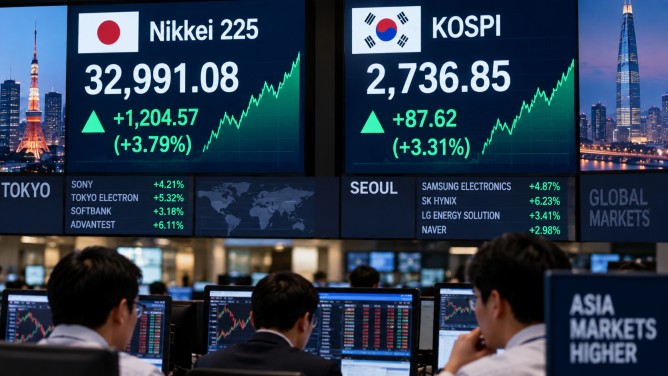
Global stock markets displayed a mixed performance on Monday, largely impacted by a notable surge in Asian markets. Leading the charge were Japan and South Korea, where technology and semiconductor stocks saw robust buying activity. The Nikkei 225 in Japan climbed by 2.1%, while South Korea’s Kospi experienced a significant 4.6% rise. Major players in the semiconductor sector, such as Samsung Electronics and SK Hynix, saw increases of 5.7% and 8.1%, respectively. Other companies related to the chip industry, including Renesas Electronics, Rohm, and Tokyo Electron, also reported substantial gains. The rally was fueled by ongoing investor interest in artificial intelligence and semiconductor enterprises, with AI-related hardware driving Asian equity markets.
In contrast, European markets remained relatively flat. France’s CAC 40 showed little change, while Germany’s DAX and Britain’s FTSE 100 saw minor declines. Meanwhile, U.S. stock futures indicated a weaker start to the week; however, U.S. markets were closed in observance of the Labor Day holiday. Elsewhere in Asia, Hong Kong’s Hang Seng index dropped by 0.9%, whereas the Shanghai Composite Index stayed almost unchanged. Australia’s S&P/ASX 200 managed to post a slight gain.
The currency markets also drew attention as the U.S. dollar weakened against the Japanese yen. This depreciation of the yen has sparked concerns among Japanese policymakers. Investors are closely monitoring potential signals from the Bank of Japan regarding any future changes in interest-rate policy.
Additionally, oil prices remained high amid continued tensions between the United States and Iran, heightening fears about inflation and the broader global economic outlook. Investors are particularly keen on upcoming U.S. inflation data and the Federal Reserve’s policy meeting in September, which are expected to provide further insight into the trajectory of interest rates.